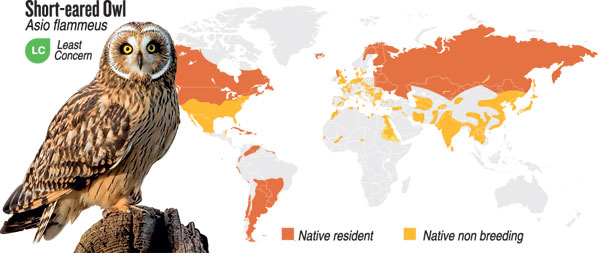
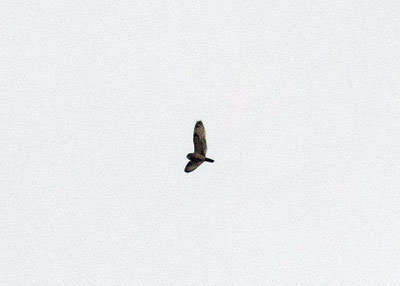
A rare migrant bird has been sighted in Sri Lanka just as the island was ready to welcome the new year. Bird observer Moditha Kodikara Arachchi had seen the bird at dusk in Attidiya, Dehiwala, where he lives. Mr. Kodikara Arachchi saw a large owl’s silhouette across the sky. The bird circled a few times, allowing him enough time to grab his camera and capture several shots before it glided towards the coast. He later identified the bird as a Short-eared Owl (Asio flammeus), a migratory bird species rarely recorded in Sri Lanka.
He has a history of documenting unique sightings in Sri Lanka. Mr Kodikara Arachchi described the encounter as magical. “I was casually scanning the skies during my usual routine when a large bird’s elegant flight pattern and distinct markings caught my attention,” he recalled. He thinks his pictures are the first photographic evidence of Short-eared Owl in Sri Lanka.
The Short-eared Owl, characterised by its striking yellow eyes, mottled brown plumage, and distinctive ‘ear’ tufts, is a medium-sized owl known for its daytime hunting habits, according to published materials. Found in open habitats such as grasslands, tundra, and marshes across the Northern Hemisphere; the Short-eared Owl migrates southward, often covering vast distances during the winter, according to publications.
Rare sighting: Short-eared owl captured by Moditha Kodikara Arachchige in Attidiya
These owls are considered rare migrants, often classified as vagrants, with sightings typically confined to northern and eastern regions. Its unexpected presence in Colombo raises intriguing questions about its migratory routes and habitat preferences.
Sri Lanka boasts over 500 bird species, and Mr Kodikara Arachchi recently celebrated recording his 400th bird species — a milestone few birders achieve.
The sighting highlights the significance of urban biodiversity and the role that individuals play in documenting and protecting it, noted Dr. Jagath Gunawardane, a veteran environmental lawyer and avid birdwatcher. Birdwatchers like Mr. Kodikara Arachchi demonstrate how personal passion can contribute to a broader understanding of wildlife.
This also underscored Colombo’s potential as a haven for diverse birdlife amid urban development, says Dr. Gunawardane who emphasised the importance of promoting citizen science in Sri Lanka. Such efforts provide valuable insights into species’ ranges and populations to help conservation efforts.
The fleeting visit of the Short-eared Owl serves as a gentle reminder of nature’s surprises and the importance of cherishing and protecting our shared environment.
As the southernmost landmass along the Central Asian Flyway for migratory birds, Sri Lanka attracts over 200 winter visitors, who start arriving from the end of August. Many of the migrants are already here but bird lovers are on the watch out for that special migrant in October.
“The Indian Pitta, known as avichchiya in Sinhala, is one of the migratory birds that arrives in October, particularly in the second half of the month,” says ornithologist Jagath Gunawardena.
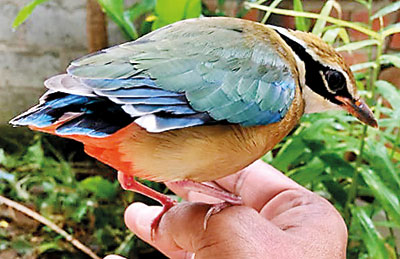
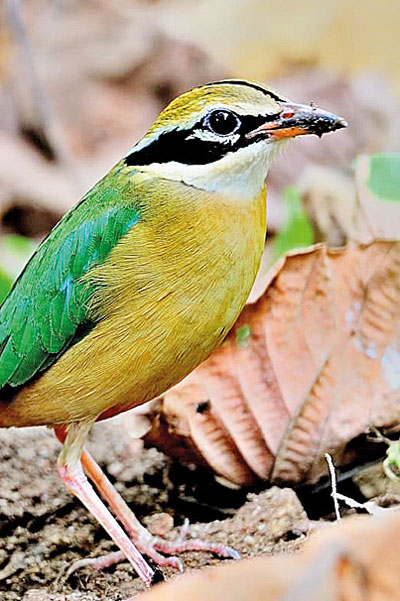
Indian Pitta found in a home garden. Pic by Sarath N. Senanayake
Being a relatively large bird, the Indian Pitta can become exhausted after long flights, leading to disorientation. As a result, these birds are often found in home gardens and even indoors during their initial arrival. This leaves them vulnerable to predations, especially domestic cats and aggressive birds like crows.
“During October and November, many wounded or exhausted birds are brought to the Wild Animal Rescue Centre in Attidiya, which is managed by the Department of Wildlife Conservation (DWC),” says veterina ry surgeon Dr. Suhada Gunawardena. If you encounter an exhausted Indian Pitta, start by inspecting it for any broken wings or wounds. In such cases, you can contact the DWC hotline at +94 11 2 888 585 for assistance.
If the bird appears healthy, keep it in a dark, quiet and warm location, safe from predators. If it seems weak, you can offer small amounts of low-concentration glucose saline with Vitamin C if it is conscious. If the bird is able to fly, release it in a safe environment, ideally at sunrise, says Dr. Gunawardena. He empahsised the importance of handling birds gently to avoid injury. “Never hold a bird by its wings, legs, or tail, as this can cause serious harm,” he cautions.
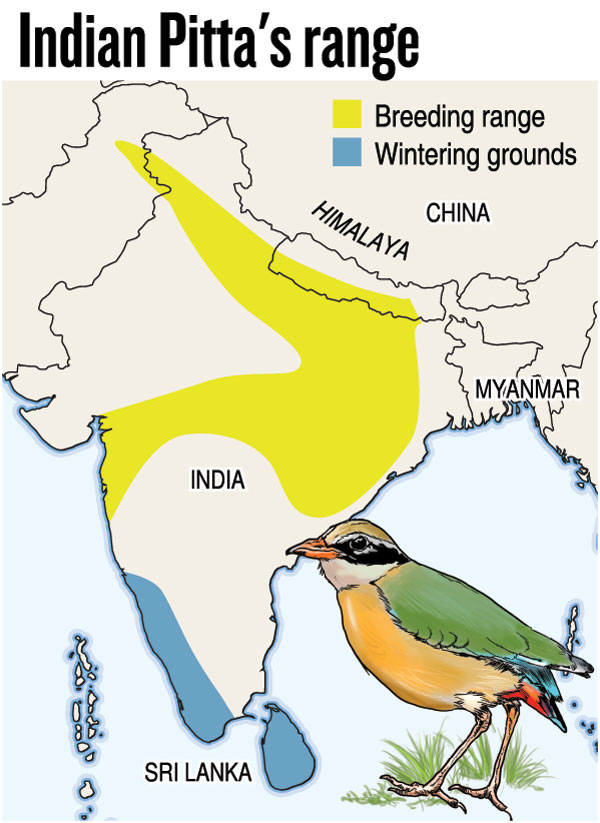
The Indian Pitta is native to northern India and typically remains in Sri Lanka until April. It is often referred to as the “Six o’clock” bird due to its habit of calling at sunrise and sunset. Some Indian Pittas tend to call more frequently before leaving their winter territories, leading some people to believe they arrive in April during the Avurudu season,” adds Dr. Gunawardena. Last Saturday, October 12 was International Migratory Bird Day for Sri Lanka and countries in the Southern hemisphere. The theme this year was “Protect Insects, Protect Birds”, highlighting the importance of insects particularly for migratory birds and concerns on the decreasing populations of insects.
The Field Ornithology Group (FOGSL), based at the University of Colombo also launched a citizen science programme, “Neighbourhood Migrant Bird Watch” inviting the public to share interesting observations of migratory birds through email arrivingmigrantssurvey@gmail.com.
Ardent birdwatcher Priyanath Kotalawela often visits his favourite birding spot along the walking path of Kimbulawela in Thalawathugoda whenever he has some time. On August 17 he was on one such stroll when he spotted a falcon. Upon closer inspection, Mr. Kotalawela realized it was a Shaheen falcon—a subspecies of the Peregrine Falcon, known as the world’s fastest bird.
Prerigrine falcon spotted at Thalawathugoda, Kimbulawala walking path. Pic by Priyanath Kotalawela
The Peregrine falcon is famous for its incredible speed, reaching up to 300 km/h (200 mph) during a stoop or dive for prey. This speed is more than double that of the world’s fastest land animal, the cheetah, which can reach speeds of up to 120 km/h (75 mph). The Peregrine falcon flies high in the sky, and once it singles out its prey, it dives rapidly. This velocity increases the power of its attack, often causing the prey to die instantly without realizing what hit it.
The Peregrine falcon (Falco peregrinus) is a rare but regular migratory bird in Sri Lanka. However, the Shaheen falcon (Falco peregrinus peregrinator), also known as the Black Shaheen, is a resident breeding bird in Sri Lanka. The Shaheen falcon has darker upper parts and rufous underparts compared to the migratory species.
These falcons roam in the city of Colombo and if carefully scan the surroundings, particularly near tall buildings or communication towers, birdwatchers may be lucky to spot the bird, says Kithsiri Gunawardena, the secretary of the Ceylon Bird Club. High-rise buildings in Colombo, such as the Bank of Ceylon and World Trade Center twin towers, are frequented by these falcons. Mr. Gunawardena recalls seeing both the Shaheen and Peregrine falcons in Kotikawatte, Rajagiriya, and even on top of the water tank of the National Hospital near his residence.
While Peregrine falcons typically build their nests on cliffs and, in Europe, on tall buildings, there are no breeding records of Shaheen falcons in Colombo. “The Shaheen falcon may be breeding in mountainous terrains on the outskirts of Colombo, and with its speed, it can easily reach the heart of the country’s busy capital,” Gunawardena told Sunday Times.
The city offers ample hunting opportunities with plenty of pigeons and other birds that are common prey for Peregrine falcons. “I’ve seen them hunting pigeons on numerous occasions,” Mr. Gunawardena told Sunday Times.
Peregrine falcons are generally seen in Colombo during the winter months when they migrate south from their breeding grounds in Europe and Asia. During this time, birdwatchers and wildlife enthusiasts have a good chance of spotting these majestic birds in action in Sri Lanka. The presence of Peregrine falcons in Colombo highlights the city’s diverse birdlife and underscores the importance of urban areas as habitats for wildlife, even for species typically associated with more remote or natural environments.
Mr. Kotalawela notes that the Kimbulawela walking path, which is about 100 meters long, is a rich birding spot. “This urban oasis is teeming with life, from migrant and resident bird species to reptiles and insects. It serves as a living classroom, teaching us the importance of preserving precious habitats even in a city,” says Mr. Kotalawela. Previously, on May 23, 2024, he recorded a Blue-cheeked Bee-eater (Merops persicus) from this same locality, marking the first record of this migratory species in Sri Lanka.
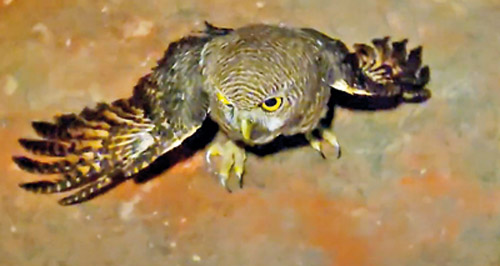
While staying at a tourist bungalow near Wasgamuwa recently, IT professional Niroshan Jayasuriya stepped out of his room one morning around 7 a.m. when he noticed the caretaker trying to console something. On closer inspection, Mr. Jayasuriya saw that it was a little owl struggling in a pool of water trapped in a cement ring.
With the caretaker’s help, Mr. Jayasuriya quickly rescued the owl from the water. “At first, we thought it was a baby owl due to its small size, but then we realized it was an adult as it had powerful talons,” Mr. Jayasuriya told the Sunday Times. They dried the owl as much as they could and wrapped it in a towel.
To their dismay, the little owl closed its eyes, appearing to give up. However, Jayasuriya wasn’t ready to give up on it. He gently rubbed the owl, trying to keep it warm, and to their delight, the owl suddenly opened its eyes.
They brought the owl inside into the kitchen and closed the doors and windows. The owl began to recover but showed signs of panic and tried to escape. Unsure of what else to do, Mr. Jayasuriya instinctively began whistling. “The owl responded to the whistle, looking at me attentively and calming down,” Mr. Jayasuriya recounted.
The owl opens its eyes after it was towel-dried and below, attempts to fly
Since it was broad daylight and the owl was a nocturnal creature, they decided to wait until nightfall to release it. They kept the owl in the kitchen until 7 p.m. before letting it go. The owl took a final look at its rescuers before flying off towards its companions in the nearby woods.
“It was one of the most joyful moments of my life,” Mr. Jayasuriya shared with the Sunday Times.
The small owl they rescued was a Jungle Owlet (Glaucidium radiatum). Native to the Indian subcontinent, this diminutive owl typically measures about 19 to 21 centimetres (7.5 to 8.3 inches) in length, with a wingspan of about 35 to 40 centimetres (14 to 16 inches). It usually weighs between 100 and 150 grams (3.5 to 5.3 ounces). Although mainly active at dawn and dusk, the Jungle Owlet is also known to call and fly during the daytime. It often roosts in tree cavities.
Lahiru Walpita, an avid birdwatcher based in Mannar, spends his days combing the beaches in search of seabirds. On the morning of July 22, at around 5.45 a.m., something caught his attention; a large seabird appeared on the horizon. The bird was following a boat.
Eagerly peering through his spotting scope, Mr. Walpita hurriedly noted the bird’s features and was thrilled to identify the unmistakable beak pattern of an albatross. Later, around 10 a.m., he spotted the bird again. This time, he managed to take some clear photographs.
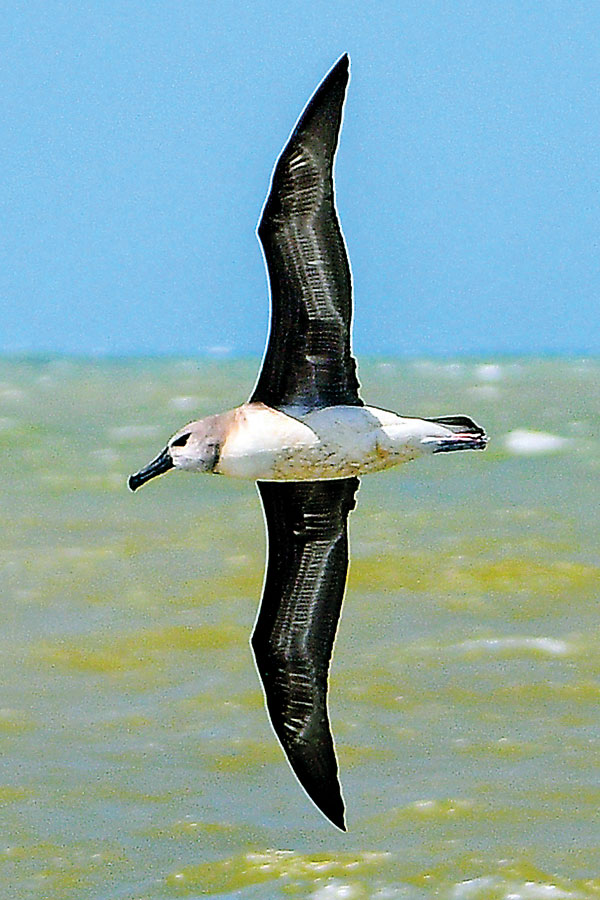
There are several species of albatross, so Mr. Walpita shared the photos with more experienced birders. With their help, the bird was identified as a grey-headed albatross (Thalassarche chrysostoma), based on its distinctive features—primarily a white body and a slate-grey head and neck.
“This could be one of the biggest finds of the century for Sri Lankan birds,” says Prof. Sampath Senevirathne, an ornithologist at the University of Colombo. There are about 30 species of albatross worldwide, most of which inhabit the Antarctic and other southern polar regions, except for three species. This is the first recorded observation of a living albatross in the Northern Indian Ocean, says Prof. Senevirathne, highlighting the significance of the sighting.
The grey-headed albatross photographed by Lahiru Walpita off Mannar.
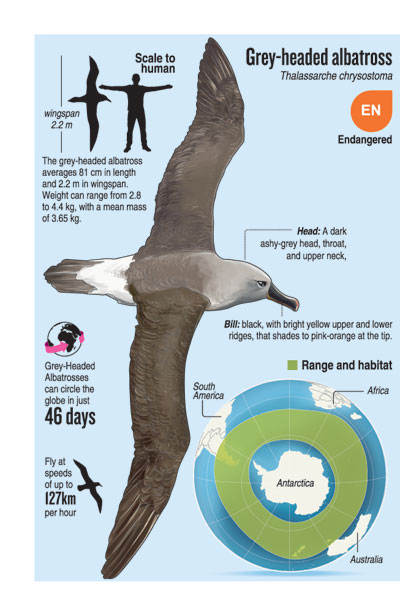
Albatrosses are large seabirds that travel long distances. The grey-headed albatross, for example, has a wingspan of 2.2 metres (7.2 feet), making it a gigantic bird when it spreads its wings. The large wingspan of albatrosses, including the grey-headed albatross, is a remarkable adaptation that enables these birds to thrive in their oceanic environment, says Prof. Senevirathne. Some species, like the wandering albatross, can have wingspans of up to 3.5 metres (11.5 feet). Their wings are long and narrow, and this shape is ideal for gliding and soaring, as it reduces drag and allows for sustained flight. Their large wings distribute their body weight, making it easier to glide efficiently over the ocean, explains Prof. Senevirathne.
The grey-headed albatross primarily flies around the South Polar region and only comes to land to raise its young. The birds lay their eggs on islands, and the parents take turns caring for the young. While one stays with the chick, the other goes to sea to forage for food, a process that can take a week or two and involves travelling across the southern ocean. Upon returning, they feed the chick a nutrient-rich substance, and then the other parent leaves to forage.
Prof. Senevirathne explained to the Sunday Times that this feeding cycle requires incredible stamina and endurance.
Albatrosses have a long lifespan, with some species reaching the age of 70 years. They require predator-free islands to lay their eggs, as they nest on the ground where small mammals like mice or snakes can threaten entire colonies. Albatrosses also have a tendency to follow fishing boats in search of an easy meal, but they often become entangled in long-line fishing hooks when attempting to take bait, resulting in drowning.
Additionally, albatrosses often mistake plastic debris for food, leading to injury, starvation, and death. Overfishing reduces the populations of squid and fish that albatrosses rely on, further threatening their survival. These factors collectively make the species vulnerable, as increased adult mortality can cause a drastic decline in the population, says Prof. Senevirathne.
The grey-headed albatross is categorised as endangered, with the International Union for Conservation of Nature (IUCN) estimating their global population to be about 250,000 to 300,000, with a declining trend. Some species of albatross have nearly become extinct, with only a few dozen surviving, Prof. Senevirathne said, adding however that international conservation organisations are taking action based on scientific methodologies to minimise the threats faced by albatrosses. This has led to some conservation successes, with populations of most being stable, he said.
Climate change is also expected to impact albatross species, as changes in ocean temperatures and currents affect the availability of prey such as squid and fish. Rising sea levels and increased frequency of storms can damage breeding sites on remote islands, which can be particularly harmful for species like the albatross that have fewer broods.
Prof. Senevirathne, who conducts research in Mannar, praises Mr. Walpita’s dedication to seabird observation, noting that seabirds are one of the most challenging groups of birds to study. He said Mr. Walpita has provided a number of dead seabird specimens he found on the Mannar coast, some of which are first-time records.
Meanwhile, Mr. Walpita told the Sunday Times that he began birdwatching seriously in 2020 and focused more on studying seabirds in 2021, inspired by a few other birdwatchers who started engaging in seabird observations. Mr. Walpita begins his birding sessions daily at 5.30 a.m., walking a 5 km stretch along the beach in search of seabirds. He also rescues seabirds that have difficulty flying and collects carcasses to send to the University of Colombo’s specimen collection.
This the season when our feathered winter visitors arrive in Sri Lanka, and ornithologists have urged the public to keep a lookout for them.
October is usually the month when the majority of migratory birds arrive. However, some of them are exhausted after their long flight.
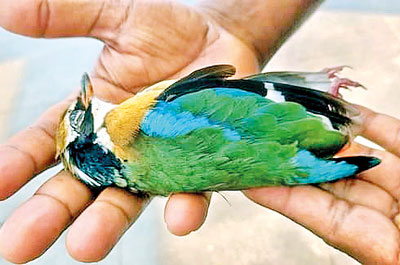
The Indian Pitta (Pitta brachyura), known as Avichchiyain Sinhala, is a colourful migrant commonly found exhausted in home gardens during this period. In the last few weeks, a number of sightings of exhausted Indian Pitta were recorded, from Colombo and its suburbs.
The poor bird who didn’t make it: Indian Pitta found in Colombo Port. Pic by Megha Attanayake
One fell dead after flying straight into a glass door in a building in Colombo Port. “The bird was flying at a high speed and died after a few minutes of the impact,” Megha Attanayake, who found the bird, said.
In another incident, an exhausted Indian Pitta who was found in a home garden in Colombo 03 was handed over to the Wild Animal Rescue Centre in Attidiya, which is managed by the Department of Wildlife Conservation (DWC). Sadly, attempts to save it failed, said veterinary surgeon Dr.Suhada Jayawardana.
Late October to early November is the time the Indian Pitta arrives here. Being a stocky bird, it can get exhausted by the continuous flight and can be found in home gardens, particularly in areas like Colombo, said Dr.Jayawardana. “Such a bird should be protected from dogs, cats, rats, crows, shikras, etc. Keep them in a dark, quiet, and warm place,” he said.
If it is too weak to fly, try giving it small amounts of low-concentrated glucose saline with Vitamin C if they are conscious, Dr. Jayawadana advised. If the bird is able to fly, release it as soon as possible in a safe environment, ornithologists urge.
The Attidiya rescue centre also received a Malayan Bittern (Gorsachius melanolophus) found in Colombo Port. This is another bird commonly found exhausted in home gardens, Dr.Jayawardana told the Sunday Times.
Meanwhile, bird lovers have reported sightings of rare migrants. Serious birdwatchers make it a point to observe birds, especially during the migratory period.
“We were at Mannar at the peak of the migration and observed many Booted eagles and a common buzzard flying from India to Sri Lanka,” Moditha Hiranya Kodikara Arachchi, an ardent birdwatcher, said. The team observed birds including the blue-throated flycatcher, Indian Pitta, orange-headed thrush, Indian Paradise Flycatcher, Indian Blue Robin, and Green Warbler. A Dunlin was also spotted in Vankalai, Mr.Kodikara Arachchi said.
About 2500 species of the 10,000 population of birds migrate due to reasons including climate change, the availability of food, and spending time in two different countries. Nearly half of the birds out of a total of around 500 bird species recorded in Sri Lanka are migratory. They start arriving in late August and stay in Sri Lanka until about March-April the following year, when they head back to their country’s of origin for breeding purposes.
The Indian Pitta arrives here late October to early November. Pic by Mohan Hathnapitiya
Monday, March 27, was the first day of a brand new school term for 5-A students of Sujatha Vidyalaya, in Matara and students rushed early to school But they were not the first to step into the freshly painted classroom. A pair of fluffy baby birds who were in a nest on a broken wall fan had also stepped out for the first time, hopping around marking a special day for them too.
The little girls were excited as this was the first time they had had such a close encounter with bird fledglings. Though the children did not do any harm, the baby birds who were trying to take their first flight got agitated and tried to fly away. One managed to fly to a nearby tree, but the other whose flight feathers were not so strong hid under a cupboard getting separated from the family.
The parent bulbul feeds its young in the classroom
However, Later in the day, the happy family with the two little ones were seen together in the school garden. The one that that was still finding it difficult to fly was seen getting a helping hand from its parents. “The bird was more cuddlesome than any of my toys, and I’m happy that it found its parents,” said an excited schoolgirl Dulithi Nethumsa.
The birds that were nesting in the Sujatha Vidyalaya 5-A class were the common Red-vented Bulbul (Pycnonotus cafer) or ‘konda kurulla’. They usually build nests inside buildings, away from predators like hawks, snakes, monkeys etc that prey on eggs and fledglings.
Though these baby birds were lucky, there are many young birds who get lost or fall from nests, especially during this peak breeding season of many common garden birds.
“These days we find many baby birds — red-vented bulbul, brown-headed barbet, and the spotted dove being the most common,” says Dr.Suhada Jayawardane, a veterinary surgeon of the Department of Wildlife Conservation’s animal rehabilitation facility at Atthidiya.
According to the bird guide, ‘Sirilaka Kurullo’ by Prof.Sarath Kotagama, yellow-billed babbler (demalichcha), oriental magpie-robin (polkichcha), white-bellied drongo (kawda), brown-headed barbet (polos kottoruwa), long-billed sunbird (sutikka), mynah, greater coucal (ati kukula), collard scops owl (karapati kan bassa), white-throated kingfisher (pilihuduwa), tailor bird (battichcha) are some of the common garden birds that breed during this time of the year.
“If one finds a baby bird that has fallen the best thing to do is to place it on a nest or keep it in a nearby location so that it can reunite it with its parents,” says Prof.Kotagama. It is important to keep a watch on the bird from a distance to protect it from predators, the ornithologist says.
If the lost bird is unable to reunite with its parents then it needs care. If the bird looks weak, then the first thing to do is try to rehydrate it with an oral rehydration liquid such as ‘jeevani’,” says Dr.Jayawardena.
The baby bird lands close to the schoolgirls who were playing while mother bird keeps a watchful gaze Pic by Malaka Rodrigo
Rukmal Rathnayake, a biologist who is involved in the rehabilitation of animals says it is also important to try to identify the bird species as different birds have different kinds of diets. For example, the Oriole feeds mainly on worms while barbets mainly have a fruit diet. But the babbler can be omnivorous. ‘Samaposha’ mixed with water is a good supplement for omnivorous as well as frugivorous birds. The mealworms available as aquarium food, egg, or smashed beef, mixed with water can also be given to insectivorous or predatory birds, Mr. Rathnayake told the SundayTimes. If the bird is too small, use a syringe to feed it, the expert says.
It is not easy to identify the species especially if the fledglings are just a few days old. However observing the beak curves or the patterns of the claws can be useful to identify the species and experts are available to give guidance on social media. “However, you should not feed milk to the bird,” Mr.Rathnayake emphasised.
Since the nights maybe too cold for lost little birds it would be a good idea to put a light bulb into the enclosure where the little bird is being kept, Dr.Jayawardane said.
The migratory bird season this year, has taken off with the first-time sighting of a Black-Winged Pratincole (Glareola nordmanni), a ‘near-threatened’ migratory bird in Kerawalapitiya – a birding spot bordering Colombo. This bird has never been seen before in this area during the migratory season.
The rare bird was spotted and identified by Malika Jayathilake and his two sons who frequent this rich birding spot. The bird was first spotted by 17-year-old Navodha on October 17. A pair was spotted by the Jayathilake family, keen birders, who identified the pair as pratincoles – a bird with short legs and pointed wings.
But the bird was different from other pratincole species found in Sri Lanka, so the family made several visits to the site to observe the bird closely. It was 14-year-old Dinidu who was interested in comparing this bird’s distinctive features with pratincoles found across the world and concluded that what they had spotted in Kerawalapitiya was a Black-winged Pratincole.
Malika posted their images of the birds on social media and expert birders confirmed their identification, adding another bird to Sri Lanka’s check list.
The Black-winged Pratincole breeds in Europe and migrates to Africa during the European winter. This is also the first time that a Black-winged Pratincole has been recorded in a South Asian region.
The Jayathilake family also spotted other firsts for the country, all from the Kerawalapitiya birding spot. A day before the Black-winged Pratincole sighting, the family observed an Ortolan Bunting, a first sighting in Sri Lanka. They had also spotted the Eastern Marsh Harrier, another rare migratory bird.
Located near Wattala bordering Colombo, Kerawalapitiya is a paradise for birds, says Malika Jayathilake. Over the past few years it has become a favourite spot for birders who have recorded sveral rare sightings. The Amur falcon, Easter marsh harrier, grey-necked bunting and the Mongolian short-toed lark are some of them.
Kerawalapitya is an entrance to Sri Lanka where birds migrate through the Western Flyway, and therefore attracts a higher number of rare migrants, says Prof.Sampath Senevirathne, an Ornithologist of the University of Colombo. The site is adjacent to the Kerawalapitiya garbage processing plant and the flies attract insectivorous birds.
Pheasant-tailed jacanas practice a system of polyandry that sees each female maintain a “harem” of males, each tasked with looking after a clutch of eggs.
That’s led to unusual parenting roles that see the males incubate the eggs and care for the young, and the females play the leading role in defending against attacks by predators.
These behaviors have been documented for the first time in a study that looked at jacanas in the Anawilundawa Sanctuary in Sri Lanka, one of six Ramsar wetlands in the country.
Researchers posit that the species evolved this system of polyandry to maximize the number of chicks that grow into adulthood, given the high mortality rate from predation in the open habitat of the wetlands.
Banner image of a male pheasant-tailed jacana incubating eggs and discharging the majority of parental duties, courtesy of Jagath Gunawardana.
COLOMBO — When it comes to super dads in the animal kingdom, the striking-looking waterbird known as the pheasant-tailed jacana is in a universe all its own. From incubating the eggs to taking care of the young, the male of the species excels. And in a reversal of the typical roles that play out in the wild, the female plays an outsized part in defending the nest and the young from predators.
These and other previously unknown details of the nesting behavior of pheasant-tailed jacanas (Hydrophasianus chirurgus) have emerged from a study carried out in Sri Lanka’s Anawilundawa Sanctuary, one of the country’s six Ramsar sites, or wetlands of international importance.
A male jacana tucks its young under the wings and moves swiftly to safety. Image courtesy of Gehan Rajeev.
“We observed the strong defense response of the pheasant-tailed jacana to intrusions and found that, in most cases, the male responds by taking care of the young when there is a threat,” said study co-author Chandima Fernando, an ecologist and geographic information system (GIS) specialist from the Field Ornithology Group of Sri Lanka (FOGSL).
The male jacana, he said, has a special way of getting the young out of danger by tucking them under its wings and moving swiftly away. But on their observation site, Fernando mostly observed the males quickly guiding the young to safe hiding spots.
The female also takes part in defending the chicks, especially against aerial threats from other birds, the study found. In fact, they played the main defensive role rather than merely supporting male defense actions against aerial threats, Fernando said.
The pheasant-tailed jacana gets its name from the elongated center tail feathers it develops during the breeding season. Image courtesy of Riaz Cader.
Super dads and defender moms
Jacana chicks are a common target for other birds, including predatory species such as the shikra (Accipiter badius) and Brahminy kite (Haliastur indus), as well as the white-breasted kingfisher (Halcyon smyrnensis), while the eggs are targeted by birds like the purple swamphen (Porphyrio poliocephalus). Brahminy kites are the most frequent attacker, and whenever they mount an aerial attack on a jacana nest, it’s the female that responds first. Female jacanas are slightly larger than the males, which could explain why they’re the ones to confront dangers from the skies.
Their response varies from making a warning call to flying up and striking a threatening pose. There are also times when the female jacana actively pursues the intruder, combat style, Fernando said. As the breeding progresses, the female’s involvement in defending the net increases, the researchers observed.
Anawilundawa is one of six Ramsar wetlands in Sri Lanka. Image courtesy of Ajith Gamage.
A wetland is an open habitat with little or no space to hide from predators, so the chicks, little fluffy balls of feathers, need to be actively protected from other threats. Water monitors abound in the Anawilundawa wetland, as do snakes and other reptiles, which all hunt the young jacanas. That gives the male bird a busy time taking care of the young, Fernando said.
The researchers studied nine breeding groups of pheasant-tailed jacanas during the breeding season, which ran from nest building to fledging state. The team divided the breeding season into three phases for better observation: pre-incubation, when a pair is involved in mating and nest building, which goes on for six to eight days; incubation, which lasts for about 21 to 26 days, when the male plays a prominent role; and chick rearing, the final 21 days, when the female’s defensive behavior is heightened.
Each female jacanas maintains a large territory, within which multiple males compete for and defend smaller territories of their own. They don’t tolerate other individuals of their own species trespassing, chasing them out if they cross the boundaries. The researchers observed that male jacanas responded to intruder males, while females responded to intruding females.
The study team used differences in individual color patterns, markings, and the length and the quality of the tail to identify the individual jacanas in the study sites, as a way to tell residents apart from intruders.
“Jacanas have a polyandrous breeding system, so the competition among males for breeding opportunities including risks of cuckoldry could be making the males more defensive of their territories from other males,” Fernando told Mongabay.
Jacanas have long toes and claws that help them hold steady and walk on aquatic vegetation. Image courtesy of Jagath Gunawardana.
Different mating system
Jacanas are tropical water birds that have adapted well to life in a lake with vegetation. They have long straight claws and toes that spread out their
weight, allowing them to walk on the floating aquatic vegetation with ease. That’s earned them the names “lily birds” and “lily trotters.” Their common name refers to the elongated central tail feathers that they develop during the breeding season.
Compared with other animals, birds typically have an exemplary family life, with about 90% of species being monogamous, i.e. a single male and a single female mating. But jacanas are a notable exception, with each female maintaining a “harem” of males, each of which in turn looks after a clutch of eggs.
“We have to do more studies to understand why some birds adapt to the polyandrous mating system, but a common understanding is that breeding strategies are basically related to the environment they live in,” said study co-author Sarath Kotagama, an ornithologist and emeritus professor of ecology who pioneered bird-watching and ornithological studies in Sri Lanka in recent decades.
The purple swamphen is among the many species that prey on pheasant-tailed jacana eggs. Image courtesy of Evarts Ranley.
The open habitats that jacanas prefer create conditions for high rates of mortality. That means there’s a real need to ensure as many chicks as possible grow into adulthood. Researchers posit that having an increased number of chicks through multiple broods could be the strategy that jacanas have evolved to increase the survival rate of the species, Kotagama told Mongabay.
Citation:
Fernando, C., Kotagama, S. W., Rendall, A., & Weston, M., (2022). Defense of eggs and chicks in the polyandrous pheasant-tailed jacana (Hydrophasianus chirurgus) in Sri Lanka: Sex-roles, stage of breeding, and intruder type. Waterbirds, 44(3), 363-369. doi:10.1675/063.044.0311
According to a news report, several Malaysian women had an embarrassing experience when they lost their undergarments that had been left to dry outside. Their initial suspect was a ‘panty thief’, but the stolen items were found in birds’ nests in the area. The ‘panty thief’ was in fact the house crows.
Crows have become a nuisance to Malaysians. The birds steal food and their droppings cause other problems.
Crow nest built with cloth hangers
Malaysia has two native crow species, but the troublemaker is house crow (corvus splendens) introduced to the country about 100 years ago. Malaysian bird experts, told the Sunday Times that these house crows had originated in Sri Lanka.
“The house crow is an introduced species in Peninsular Malaysia and Singapore and based on what we know, the house crow was introduced to this part of the world from individuals who imported them to the state of Selangor in Malaysia from Sri Lanka when both countries were ruled by the British,’’ said Dr. Yong Dingli, regional flyway coordinator of BirdLife International based in Singapore. The crows had apparently been imported to control pests in plantations, Dr. Yong said.
The global invasive species database managed by the IUCN states that the house crow has been established in at least 25 countries as an invasive species. The Invasive Species Compendium (CABI) states that the first introduction was in the 1870s from Sri Lanka to control a plague of caterpillars. The reports indicate 56 house crows were imported from Sri Lanka to Port Klang. According to the book, Birds of the Thai-Malay Peninsula, these birds were captured from somewhere near Mt. Lavinia.
From a study of the genetic diversity of native and introduced populations in Asia and Africa, researchers found that the lowest genetic diversity was found for the intentionally introduced population in Selangor, Malaysia, proving that Sri Lanka should be the source population for Selangor consistent with a documented introduction over 100 years ago.
The reason for more diverse genetic diversity of crows in other areas of Malaysia could be that crows could also spread through shipping.
“It is also possible that house crows could also arrive in the region through shipping connecting ports,” Dr. Yong said.
The house crow, famously known as ‘kolamba kaputa’ is native to South Asia, but is now found in the Malay peninsula, certain parts of Africa, and even Victoria in Australia.
The kaputa is also a threat to native creatures.
Singapore has successfully managed to keep them at bay.
Although ‘kolamba kaputas’ are not panty thieves, they steal other artificial items to build nests. Clothes hangers are one of their favourite items.
Though not attractive, crows are known for their cunning behaviour and intelligence.
Experiments have shown how a crow drops stones into a water container to lift the water level to drink.
The cafeteria of the University of Colombo was a place from where crows were found to be stealing items.
Prabath Rodrigo, recalled: “I had left my food plate to wash my hands. A crow came from nowhere and stole the egg. Nobody would believe this if they had not seen it.’’
Still, kaputas have been shown to be dumb when defending its nest. The koel, or the cuckoo, lays its eggs on a crow’s nest.
Instead of whistling a happy tune, crows cackle and squawk in irritating patterns.
But crows are also known for their brotherhood. They alert other family members when they find food. They also roost communally where crows in one area choose a tree to spend the night.
They often nest with mynas which are also known to roost in groups.
The large tree near the Borella cemetery is one such example.
The Field Ornithology Group of Sri Lanka (FOGSL) has been doing a roosting count of crows of Colombo for the past 40 years. Records that the crow population in Colombo peaked in 2006, but declined in 2012.
Prof. Nihal Dayawansa, the group’s president, said open garbage dumps and irresponsible disposal of food are factors in the population of crows rising.
In 2010, the then government under Mahinda Rajapaksa began a programme to make Colombo beautiful while closing a number of open garbage dumps. Prof. Dayawansa said that this would have resulted in the decline in Colombo’s population of crows.
A flamingo colony of about 5,000 has become an attraction in Mannar these days.
Mannar’s arid landscape sometimes is an eyesore, but many of its coastal areas and lagoons have come alive with shades of pink and white from a flock of flamingos. During the long weekend last week, last-minute travelers could not find accommodation as bird enthusiasts flocked to Mannar.
Mannar causeway, Vankalai Sanctuary, saltern, and the coastal area near the airstrip, are some of the spots where the birds can be seen. The colony sometimes visits areas nearer the main road and busloads of people stop by.
“Usually, the average number of a large flamingo flock consists of about 2,000, but the flamingo colony in Mannar these days has about 5,000, and this is the largest flock I’ve seen in Sri Lanka,” said Prof. Sampath Senevirathne, an ornithologist of the University of Colombo. He visits Mannar for fieldwork.
The flamingos are a migratory species that usually arrives in November and stays in Sri Lanka until about March. Prof. Seneviratne says this flock arrived in Mannar in the first week of January and could be the birds that breed in India’s Gujarat region.
In the past two years, the birds have been missing from Mannar. In 2019, a large number of flamingos together with many other migratory birds were found dead in India following a storm.
“About 70% of the birds in the Mannar’s flamingo flock consist of sub-adult birds that are pale in color, so this could be the same flock with its members that are growing after successful breeding during the past two years,” Prof Seneviratne told the SundayTimes.
The Greater Flamingo (Phoenicopterus roseus) is probably the most notable migratory bird species due to its beauty. According to National Geographic, this tall bird has long, lean, curved necks and pinkish legs. The flamingo’s pink beak has a black tip, and the bird uses its downward bent bill to filter-feed tiny organisms like plankton, tiny fish, and larvae in mudflats or shallow waters. Shrimp-like crustaceans provide the nutrition that helps to maintain the pink in their body, National Geographic says.
In Sri Lanka, the lagoons, mudflats, and shallow coastal waters in Jaffna and Mannar are the most popular locations for the flamingos. Until late ’90s, large flocks could be seen in Bundala Wetland in the south, but no longer.
“The reason for Bundala losing its flamingos is a result of the diversion of a large amount of irrigated freshwater to the Bundala Lagoon,” says Prof. Sarath Kotagama, an eminent ornithologist.
The flamingo filter feeds tiny organisms, but they need brackish water. When there is a lot of freshwater, the salinity of the Bundala lagoon changes, killing the organisms that the flamingo feed on. So the flamingos left Bundala looking for new feeding grounds, he said. “If the irrigated freshwater could be diverted elsewhere, the flamingos could start visiting the Bundala Lagoon again,” he said.
This Heuglin’s Gull has become the first migratory bird to Sri Lanka tracked with GPS to have completed a full migration cycle. It is also the first known bird to have flown to the European Arctic from Sri Lanka.
A migratory gull’s return to Sri Lanka from northern Russia has been charted in a milestone joint project in which researchers used a global positioning system transponder fixed to the bird.
The team tracked a Heuglin’s Gull which flew to the edge of the Arctic in northern Russia from Mannar. It was tagged on April 4 this year, but had flown from Sri Lanka after 20 days. The gull they named ‘Menike’, had flown a total of 19,360 kilometres.
It flew 7,880km over 35 days to reach its breeding grounds in Yamal Peninsula in northern Russia in the Arctic region and began the return journey in late August. The bird made several stopovers over 91 days and arrived in Mannar on November 4 — six months and nine days after leaving Sri Lanka.
“With her safe arrival, ‘Menike’ becomes our first tagged bird to complete a full migration cycle and also the first known bird to travel to the European arctic from Sri Lanka,” says Prof. Sampath Senevirathne and Gayomini Panagoda, who led the team.
This study is a joint project by the Field Ornithology Group of Sri Lanka (FOGSL) of the University of Colombo and the Research Center for Eco-Environmental Sciences of the Chinese Academy of Sciences.
Mannar was chosen because this is where many migratory birds first enter Sri Lanka.
The team had received 35 GPS tags which they also fixed on other migratory birds.
The Heuglin’s Gull is a large white-headed bird found only in the north-western and northern coastal regions of Sri Lanka during the migratory season. It is a member of Lesser Back-backed Gull (Larus fuscus) complex, which consists of five similar looking gulls.
Prof Seneviratne said the migration and breeding destinations of the Larus fuscus Gulls spending winter in South Asia are not well-understood, “so we specially want to tag a bird also with intention to study the boundaries of the ‘Central Asia Flyway’, where birds used to migrate to Sri Lanka’’.
The team tags the Heuglin’s Gull in Mannar on April 4 this year. The bird flew away 20 days later and returned in November.
“Though it reached its breeding grounds early, ‘Megha’ was a bit late to initiate his southward journey, leaving the Arctic only in early October. ‘Megha’ is now close to Sri Lanka, and we expect it to reach us in a few days,” Ms Panagoda told the Sunday Times.
A Brown-headed Gull they tagged had crossed the Himalayas in May this year. It was only the third bird to have crossed this extreme height.
The FOGSL together with the Department of Wildlife Conservation (DWC) initiated Sri Lanka’s National Bird Ringing Programme centered in Bundala in 2004 under the guidance of Prof. Sarath Kotagama.
“GPS-tracking helps to understand the pathways of the birds and can lead to solving many mysteries of bird migration,” says Prof. Kotagama.
Prof. Seneviratne says the Wetland International, DWC and Sri Lanka Navy and the local sponsors Palmyrah House and the Vayu Resort in Mannar too should get credit for the project.
The team also tagged a second Heuglin’s gull named ‘Megha’ which flew away on April 4. It was the first to reach northern Russia by mid-May, says Gayomini Panagoda who is working on a doctoral project.
A common bird found in coastal Sri Lanka during the early part of the year has for the first time been tracked on its heroic flight high above the Himalayan mountains after being fitted with an electronic tag by researchers in Mannar.
“The tagged brown-headed gull crossed the Himalaya range flying at an altitude of 18,153 feet (5,533m). It had to fly even higher on its last stretches of the flight over the Tibetan Plateau, reaching heights of 21,140ft (6,443m)” researcher Dr. Sampath Seneviratne said.
The brown-headed gull (Chroicocephalus brunnicephalus) was caught and tagged in April by Dr. Seneviratne’s team in Mannar. The electronic tag emits signals giving the bird’s location wherever it flies. The signals are picked up by satellite. The gull left Sri Lanka a few days after being tagged and continued to fly northward toward its breeding ground. It could be a journey this brown-headed gull had already made a few times previously but, on this occasion, it left an electronic trail revealing its heroic flight.
According to the data, the gull crossed the Himalayan range, flying between the mountains of Manaslu (8,163m) and Nemjung (7,140m), in the first week of May and settled on the Tibetan plateau to breed. Himalaya, with its tall mountain ranges, Everest the highest at 8,849m, is known as the roof of the world. Gusty winds, subzero temperatures and low oxygen levels make survival a challenge there, which makes the journey of the brown-headed gull so marvellous.
Ornithologists have found through visual observation that bar-headed geese fly across Himalaya. More recently, the demoiselle crane and steppe eagle have also been recorded there. The record of the brown-headed gull is only the third confirmed by tagging, Dr. Seneviratne said.
The satellite tagging project is a joint collaboration between the Field Ornithology Group of Sri Lanka (FOGSL) based at the University of Colombo, the Chinese Academy of Sciences (CAS) and Wetlands International, with support from local sponsors with Palmyrah House in Mannar become the main contributor. CAS provides the satellite tags and associated technology to FOGSL, which selected Mannar as the project site as it is a hotspot for migratory birds coming to Sri Lanka.
Traditionally, bird rings are used to monitor bird movements. A plastic or metal ring with a unique coding that helps to identify the place of the bird’s origin is put on a bird’s leg. When the bird wearing this ring is found in a different location it confirms the bird has travelled from one of these locations to the other.
“But these traditional rings do not reveal the movements of the bird in between, so the satellite tags and other electronic tags revolutionised migratory studies,” Professor Sarath Kotagama said. Prof. Kotagama started the National Bird-Ringing Programme in 2004 through FOGSL in collaboration with the Department of Wildlife Conservation.
As the technology behind electronic tags is expensive, Dr. Seneviratne spent years pursuing a partner to initiate a satellite-tagging programme. Finally, the Chinese Academy of Sciences partnered with FOGSL to provide the technology and the satellite tags to begin the project last year in Mannar. These tags use a GPS/GSM transmitter to send information about the location of the bird, its speed, and the height of its flight. The data is received and distributed through servers using the earth’s mobile networks.
Gayomini Panagoda, a Ph.D. candidate of the University of Colombo, who is using the tagging project as her thesis, says there is careful selection of the bird species to be tagged. The team received 35 tags last year. The birds selected included the Eurasian wigeon, common redshank, whimbrel, crab plover, bar-tailed godwit, black-tailed godwit and the Caspian tern).
One bird that was tagged, the Heuglin’s gull, is regarded as special by the team. “It breeds on the rim of the Arctic in northern Siberia in Russia, so we wanted to tag this bird to study its migratory routes,” Ms Panagoda said. “The Heuglin’s gull flew about 8,000km in 35 days to reach its breeding grounds and is now on its return journey back toward Sri Lanka for this migratory season.”
The Central Asian Flyway (CAF) is a route for migratory birds coming from areas between the Arctic and Indian oceans, and Sri Lanka is the last landmass on the southern boundaries of this flyway. “The boundaries of the CAF are only broadly defined and poorly understood, so we aim for species that represent … the species that visit us from both the high Arctic and temperate latitudes to capture the full spectrum of migration systems within the flyway” Prof. Seneviratne said. Ms. Panagoda said the team received a second batch of 35 tags for this season of migrants, and have already begun work.
Saturday marked migration season in south
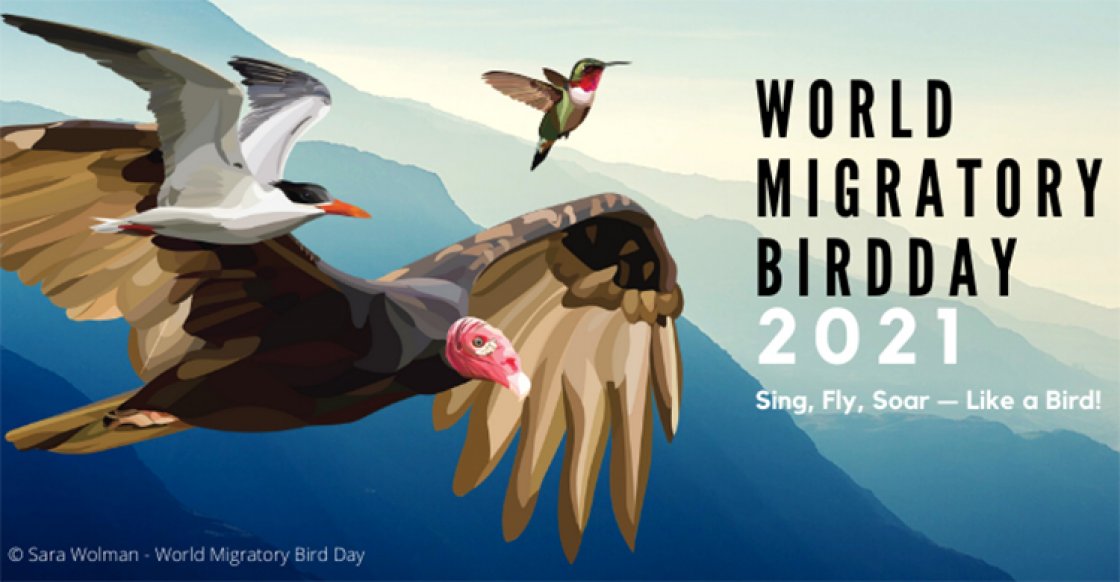
The second of the World Migratory Bird Days (WMBD) yesterday, marked the arrival in countries such as Sri Lanka of birds from northern climes to “winter” in warm countries.The second Saturday in May marks the other bird day, when migratory birds fly to northern regions of the world.The theme for yesterday’s event was “Sing, fly, soar – like a bird!”, focusing on the phenomena of birdsong” and bird flight as a way to inspire and connect people around the globe in a desire to protect migratory birds.Climate change is adding pressure on migratory birds by adversely affecting the habitats they need for breeding, resting and refuelling along the way.Mid-October is when common migratory birds such as the Indian pitta (known as avichchiya in Sinhala) come to Sri Lanka. As it is a bulky bird, many become exhausted and ended up disoriented in many home gardens.The Field Ornithology Group of Sri Lanka (FOGSL) is holding a lecture on October 16 to educate people on what to do if an exhausted migrant is found in home gardens. Email migrantwatch.srilanka@gmail.com to register for the lecture.
While the dual citizenship of presidential election candidates has been a hotly-debated topic in the political arena, it is expected that thousands of other “dual citizens” will be in Sri Lanka by election day in November.
Exhausted Indian Pitta found fallen on 28.10.2018. Pix by Sarath N. Senanayake
Some of them are eligible for European passports while others come from Asian countries.
None, however, will come through immigration channels, and they do not care at all about the political drama in Sri Lanka.
These dual citizens are migratory birds that come here annually from northern countries at this time.
About 2,500 of the 10,000 world bird species engage in long-distance migration as a response to changing weather and the availability of food, spending their life in different countries.
Nearly half – 245 species – of the 508 bird species recorded in Sri Lanka are migratory and generally begin arriving in late August, staying on here until about March-April next year before returning to their country of origin to breed.
“As the main steps of the migratory routine are predictable and move in a rhythm, bird migration can be considered to be like a ballet dance – in fact, bird migration could be called the greatest dance in the world,” ornithology expert Dr. Sampath Seneviratne told the Wildlife and Nature Protection Society this week.
A helping hand for the Indian Pitta
“Birds that breed in European countries such as Russia, and in Asian countries such as China, Mongolia, Afghanistan and India, migrate to Sri Lanka.
“We need more research on migratory patterns as there is a lot to unravel,” said Dr. Seneviratne, President of the Field Ornithology Group of Sri Lanka (FOGSL) and a senior lecturer at the University of Colombo.
Historically, migrating birds are believed to have arrived in Sri Lanka along three main routes to Sri Lanka, using designated pathways. This view was based on observations carried out in colonial times.
“It is time to have more advanced research to link the dots with the use of new technologies,” said Dr. Seneviratne.
The traditional method of researching migration is carried out with the use of rings fixed on birds’ legs.
If a bird with a ring fixed by ornithologists in one country is found in another country it acts as proof of presence of the bird at two locations.
Science has led to improvements in tracking. The new trend is “geo-tagging”, in which scientists place a satellite tag on a bird. The tag emits signals that pinpoint the bird’s location.
Dr. Seneviratne said satellite tracking by India has led to findings that contradict traditional knowledge of the main routes used by birds migrating to Sri Lanka.
“Geo-tagging is expensive, so we can’t do it in Sri Lanka at this point,” he added.
A national bird-ringing program carried out by FOGSL and the Department of Wildlife Conservation (DWC) under Professor Sarath Kotagama has revealed interesting patterns such as the same birds migrating annually to the same site – sometimes to the same plots – in a pattern used by their ancestors.
“Some people believe the ringing process puts birds in danger. But this is a myth and it is perfectly safe, and I’m bit disappointed when I hear such allegations,” the FOGSL President said.
“We need science, and without understanding birds, their behaviour and their migratory patterns it is not possible to conserve them.”
An unusually large bird found this week on Muthu Panthiya island in Chilaw drew crowds as it had never been observed on land. Stricken by curiosity, the villagers caught the bird and handed over to the Anawilndawa wildlife office.
The bird, blackish with white underparts, had a very long, hooked beak and a wide wingspan and looked clumsy on the land, unable to perch properly. It was later identified as a frigatebird – a large seabird inhabiting tropical and subtropical ocean regions.
Frigatebirds are occasionally observed flying on the sky, but it is very rare to find one on land in Sri Lanka.
Named after a fast warship, frigate birds are fast on the wing, sometimes attacking other birds to steal their fish catch and snatching baby birds from other seabird colonies.
There are five species, and experts believe this bird could be a Christmas Island frigatebird (Fregata andrewsi) or great frigatebird (Fregata minor).
Seabird expert Gary Allport of BirdLife International identified the bird in Chilaw through photographs as a female greater frigatebird aged two or three years.
“Greater frigatebirds are common in the Maldives and the strong monsoon winds could have assisted the bird’s passage from the Maldives to Sri Lanka [about 600km],” seabird expert Rex I. De Silva said.
“The presence of a Christmas Island frigatebird would be more difficult to explain as the bird would have to battle strong monsoon headwinds for approximately 3,600km to get here”.
Mr. De Silva said frigatebirds are notoriously difficult to identify as in a particular growth phase one species could resemble another in a different phase.
Frigatebirds have long and pointed wings that can span up to 2.3metres (7.5 feet). This is the ratio of largest wing area to body weight than any other bird in the world.
The birds feed on fish picked from the ocean’s surface while in flight.
The recent strong monsoon winds and weather might have helped bring the frigatebird to Sri Lanka’s western shores. Just a day prior to its discovery in Chilaw, Mr. De Silva, on his social media platform, “Seabird Watch (Sri Lanka)”, posted a note that the bad weather should be ideal for observing the seabirds as this is also the period of a mass seabird migration.
“August-September is in fact the best time to observe the great mass migration of seabirds. During the peak in September as many as 3,000-4,000 bridled terns (Sterna anaethetus) fly southwards within sight of shore in one hour,” states Mr. De Silva who has studied this fascinating phenomenon over many years.
Many seabirds take part in long annual migrations, crossing the equator after the breeding season. Nearly 50 seabird species have been recorded on the west coast of Sri Lanka.
One of the main studies conducted by Seabird Watch (Sri Lanka), a 13-year study of the mass migration of bridled terns off the west coast, is the most comprehensives and long-lasting study on seabirds in the northern Indian Ocean.
BirdLife International, the umbrella organisation of world’s bird conservation organisations states seabirds have become the world’s most threatened bird group, recording steep declines in populations almost everywhere.
There are only 2,400-4,800 mature Christmas Island frigatebirds thought to remain in the wild according to the International Union for the Conservation of Nature.
As the annual initiative, Great Backyard Bird Count (GBBC) from February 15-18–where birdwatchers around the world are invited to count and report details of birds in the area in which they live– marks its last day tomorrow, a veteran ornithologist here has said it was important to keep a tab on what are regarded as common birds too.
Prof. Sarath Kotagama says that while many are concerned about the declining numbers of rare birds, the numbers of common birds, too, could dip towards extinction without anyone realising it and, therefore, it was important to take a count of those birds too.
The latest ‘State of the World Birds’ report published by BirdLife International reveals that while highly threatened species continue to go extinct, what were once considered common and widespread species too are in sharp decline. At least 40% of bird species worldwide (3,967) have declining populations, compared with 44% that are stable (4,393) according to the report.
“As the birds around are mostly common ones, even an amateur birdwatcher can identify most of the birds around us. So the public too can join in such citizen science initiatives such as the GBBC and make note of the common birds which can be an indicator of the state of the environment,” Prof.Kotagama explained.
Red-vented Bulbul. Pic by Hari Namasivayam
The global Great Backyard Bird Count (GBBC) is a citizen science project conducted annually in mid-February. During this four-day event birdwatchers around the world are invited to count and report details of birds in the area in which they live.
The Field Ornithology Group of Sri Lanka (FOGSL) based at Colombo University urges Sri Lankan birders also to participate in GBBC. “The migratory birds are still in Sri Lanka in mid-February, hence the timing of the GBBC is good to get an annual snapshot of birds here,” FOGSL president Dr.Sampath Seneviratne said.
“The GBBC is also a great opportunity to introduce not just adults, but children too to birding and build greater awareness of our biodiversity and its conservation. So get your kids to participate in this event,” urges Dr.Seneviratne.
Meanwhile pointing out that the Bombay Natural History Society (BNHS) has announced its first coordinated flamingo count in the region on February 23 and 24, Dr.Seneviratne said that FOGSL will carry out a similar programme here too on the same days. He invites birdwatchers here to be a part of the programme by calling the FOGSL hotline on 0789330076. The Greater Flamingo (Phoenicopterus rosues) is a common winter visitor to Sri Lanka, and birdwatchers and wildlife photographers flock to Mannar and other northern regions to get a glimpse of the spectacular gathering of hundreds of these birds.
Flamingos (c) Janaka Bandara
How to participate in the Great Backyard Bird Count Participants are asked to count birds for as little as 15 minutes on one or more days of the four-day event and upload their sightings on eBird (http://www.ebird.org).
If you find it difficult to access eBird, make a list of the birds seen around in your area their numbers and details of the location, sounds etc and email to gardenbirdwatch.srilanka@gmail.com urges FOGSL or call their hotline 0789330076 for any assistance.
Cattle Egret is a common bird – but can you spot this bird in your area these days..? The photos show ground of University of Colombo on the morning of 26th of May 2018. There were 55 Cattle Egrets foraging on the wet ground with number of them in full breeding plumage. The birds started gathering few days prior, where about 35 cattle egrets were counted on University Grounds on 22nd of May. On 22nd of May; Prof.Kotagama pointed out this could be a congregation before a seasonal movement/ migration and when I visited university of Colombo on 4th of June – not a single Cattle Egret could be spotted.
Elsewhere (in India), it researchers observed Cattle Egrets show seasonal movements during their breeding season along with the monsoon – getting disappear in June and emerge back in September. So our cattle egrets too could be following a similar pattern without our notice.
So do observe cattle egrets and report cattle egret sightings. If you remember an area where cattle egrets were present earlier, please make a visit this week to the location to find out whether they are still there. You can send observations to gardenbirdwatch.srilanka@gmail.com.
Following is an article about the phenomena appeared on Vidusara 20.06.2018
A cattle egret in breeding plumage (c) Evarts Evarts
Kirulapana Barn owl showing its beauty (c) Shantha Jayaweera
The barn owl is a rare bird in Sri Lanka categorized as ‘near threatened’ in the 2012 National Red List, but it wasn’t an April Fool’s joke that one was seen in Kirulapona on April 1.
It had been attacked by crows and had fallen from the roof of a four-storey building, where it had taken refuge. It was handed over to wildlife expert Shantha Jayaweera who later released it. “Even through it had been attacked by crows, there were no external injuries.”
The barn owl (tyto alba) is a beautiful owl species with a whitish face, chest, and belly, and buffy upper parts. Its scientific name means, ‘white owl’. Barn owls have adapted to living among humans. Granaries, warehouses, old buildings where its favorite prey, rats and mice, live attract the owl.
Mr Jayaweera thanks all those who ensured the owl’s safety. He stressed that owls do not represent a bad omen, but helps to remove harmful pests such as rats. According to National Geographic, on average, a wild barn owl eats about four small mammals a night. That is 1,460 rats per year.
The barn owl is about 34 centimetres in length but its long wings make it looks bigger and elegant when flying. It mainly hunts by sound rather than by sight where its acute hearing can detect the slightest movement and sound of its prey.
The barn owl’s heart-shaped face collects sound in the same way as human ears and its hearing is the most sensitive of any creature tested, according to some literature. Barn owls are faithful lovers. A pair mates for life unless one gets killed. It breeds between February and March.
Mr Jayaweera, who is a senior member of the Young Zoologists Association, recalled that the National Zoological Gardens once received an injured barn owl from a public library few years ago. Responding to a post on social media, many shared sightings in Colombo and the suburbs.
“I have seen barn owls in Duplication Road, Fife Road, and near the Golf Club,” said Rex I De Silva.
Namal Kamalgoda had seen one in Town Hall, the National Museum and also in Dehiwala.
Others reported sightings in Pettah, Fort and surburbs such as Kottawa, Moratuwa and Ratmalana.
The rescued barn owl with Shantha Jayaweera
Environment lawyer, Jagath Gunawardane, who is also an expert on birds, stressed that unlike other rare birds of Sri Lanka, the barn owl is mostly found in old buildings in towns.
Another bird expert, Moditha Hiranya Kodikara Arachchi, shared an observation of a barn owl in Kandy inside the old Electricity Board building. “This barn owl was day-roosting on fans in the office without any trouble, until it was chased away because of droppings all over the office,” he said.
Experts fear that rat poison could harm these owls. According to the Barn Owl Trust, even a rodent eating a dose is not enough to kill it, and it may carry the poison in its liver for several months. So, before a poisoned rodent dies, the weakened rat may be caught by a barn owl, which then ingests the poison. Unfortunately, no research has been carried out on the effects of sub-lethal doses on wild barn owls.
“There could be a viable population of barn owls throughout Colombo and many other urban areas. It is an iconic bird in our urban settings,” said veteran ornithologist, Prof Sarath Kotagama.
He is inviting the public to share their barn owl sightings in Colombo and suburbs. Note the date and location by email:urbanbirds.srilanka@gmail.com or call 071- 8440144.







 Window to Nature